Research - Satellite constellations - rosettes with intersatellite links and double surface coverage
 A rosette satellite constellation with intersatellite links has two locally-separate surfaces of interconnected satellites over ground terminals - one mesh of interconnected satellites ascending, i.e. moving northward from south to north, the other mesh descending from north to south.
This layering of redundant meshes affects satellite coverage, the network design for that constellation, and routing of traffic across that constellation.
The redundancy of two overlapping mesh fabrics arguably makes the second layer of intersatellite links unnecessary, which is why low-orbit constellations
with intersatellite links began by using polar Walker star geometries with a single mesh layer (a cut torus), and not inclined Ballard rosettes or Walker
delta constellations (spindle tori). Connecting the overlapping meshes locally is considered difficult, as the ascending and descending satellites move
past each other rapidly, requiring very fast tracking and frequent intersatellite link handovers.
The deployed Iridium and Iridium NEXT are polar Walker stars with intersatellite links. Teledesic, most famously, and LeoSat,
most recently, proposed the same. Rosette constellations using intersatellite links must take account of this coverage property: in the 1990s, Motorola's
M-Star and then Celestri were proposed. Telesat Lightspeed is one planned example.
This describes the double surface property within a single rosette constellation. Larger constellations that increase capacity with added orbital shells
(which are themselves full constellations) increase the routing and traffic delay problem: just as you don't want a ground terminal to hop to the other
mesh of satellites and back, you don't want the terminal connecting to another shell and then returning. As multi-shell rosette constellations,
SpaceX's Starlink and Amazon Leo (formerly Project Kuiper) must consider this.
Academic work related to double surface coverage includes:
- Thoughts on research for space networking, Lloyd Wood, IEEE Space-Terrestrial Internetworking (STINT) Workshop, 29 July 2021.
- Using Inter-Mesh Links to Reduce End-to-End Delay in Walker Delta Constellations, Xiaoxin Qi, Bing Zhang, Zhiliang Qiu and Ling Zheng, IEEE Communications Letters, July 2021.
- A Simulation Tool to Study Routing in Large Broadband Satellite Networks, Benjamin Sky Kempton, Master of Science thesis, Christopher Newport University, 2020. ISBN: 9798662568945 (github, related)
- Network topology design at 27,000 km/hour, Debopam Bhattacherjee and Ankit Singla, Proceedings of the 15th International Conference on Emerging Experiments and Technologies (CoNEXT '19), December 2019, pp. 341-354 (simulations, video, press release, APNIC blog and presentation at APNIC 50 (10 minute mark), IRTF Applied Networking Research Prize presentation).
- Starlink is a very big deal, Casey Handmer, blog post, 2 November 2019, has some discussion of the toroidal nature of that satellite constellation.
- Delay is Not an Option: Low Latency Routing in Space, Mark Handley, Proceedings of the 17th annual ACM Workshop on Hot Topics in Networks (HotNets), pp. 85-91, November 2018 (press coverage and animation announced, video and commentary.) This attempts to connect the counter-rotating surfaces together with cross-seam links between crossing counter-rotating planes, based on an indication in early SpaceX filings of five intersatellite link terminals per satellite. SpaceX changed that in later filings and has since launched over five hundred satellites without intersatellite links.
- A Shortest Path Routing Algorithm based on Virtual Coordinate in NeLS, Qiuwen Chen, Kechen Zheng, Feng Ouyang, Xiaoying Gan, Youyun Xu and Xiaohua Tian, 8th International Conference on Wireless Communications & Signal Processing (WCSP), October 2016.
- A Distributed Routing Algorithm for LEO Satellite Networks, Yanpeng Ma, Wei Peng, Wanrong Yu, Jinshu Su, Chunqing Wu and Guohong Zhao, 12th IEEE International Conference on Trust, Security and Privacy in Computing and Communications (TrustCom), July 2013. (author copy)
- A Location Management Algorithm for LEO Satellite Networks, Yanpeng Ma, Wei Peng, Xiaofeng Wang, Baokang Zhao, Jinshu Su and Chunqing Wu, 12th IEEE International Conference on Trust, Security and Privacy in Computing and Communications (TrustCom), July 2013 (author copy).
- A distribute and geographic information based routing algorithm for LEO satellite constellation networks, Yanpeng Ma, Jinshu Su, Chunqing Wu, Jinshu Su, Xiaofeng Wang, Wanrong Yu, Baokang Zhao and Xiaofeng Hu. Sixth International Conference on Innovative Mobile and Internet Services in Ubiquitous Computing, July 2012 (author copy).
- A source-based share-tree like multicast routing in satellite constellation networks, Yanpeng Ma, Jinshu Su, Chunqing Wu, Xiaofeng Wang, Wanrong Yu, Baokang Zhao and Xiaofeng Hu, Third FTRA International Conference on Mobile, Ubiquitous, and Intelligent Computing, June 2012 (author copy).
- Network Controlled Handover for Improving TCP Performance in LEO Satellite Networks, Hiroshi Tsunoda, Umith Dharmaratna, Nei Kato, Abbas Jamalipour and Yoshiaki Nemoto, IEEE Globecom 2006, San Francisco, December 2006. as double mesh coverage.
- QoS Handover Management for Multimedia LEO Satellite Systems, Stylianos Karapantazis and Fotini-Niovi Pavlidou, Telecommunication Systems, Springer, vol. 32 no. 4, pp. 225-245, August 2006.
- A Satellite Selection Method for Walker Delta LEO Satellite Networks, Umith Dharmaratna, Hiroshi Tsunoda, Nei Kato and Yoshiaki Nemoto, IEICE Transactions on Communications, vol. 87 no. 8, pp. 2124-2131, August 2004.
- Topological design, routing, and handover in satellite networks Afonso Ferreira, Jérôme Galtier, and Paolo Penna, Handbook of Wireless Networks and Mobile Computing, pp. 473-493, February 2002 (author copy - see also Klee's Measure INRIA Tech Report).
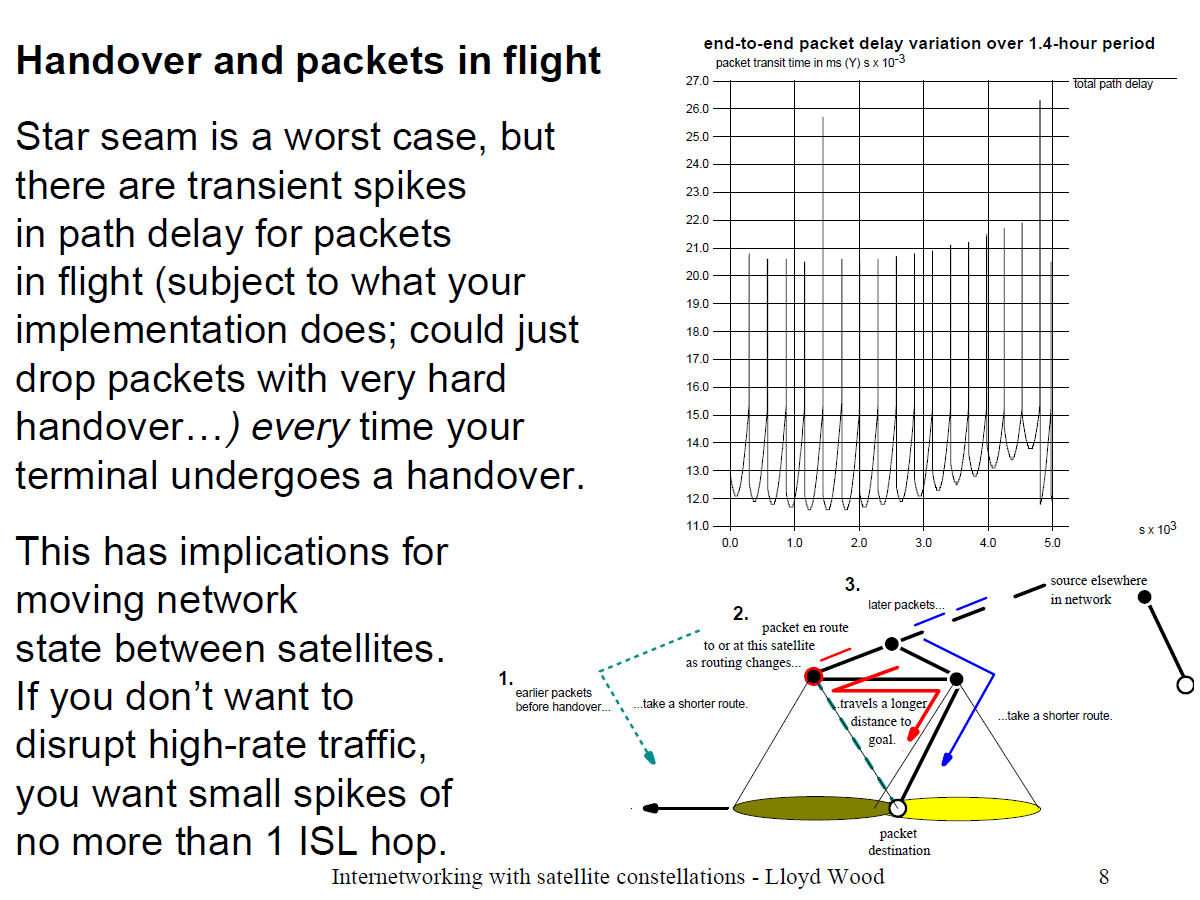
- Internetworking with satellite constellations, Lloyd Wood, thesis for award of Doctor of Philosophy (PhD), University of Surrey, June 2001. Ch. 6 expands on the paper just below.
- Managing diversity with handover to provide classes of service in satellite constellation networks, Lloyd Wood, George Pavlou and Barry Evans, 19th International Communication Satellite Systems Conference (ICSSC '01), vol. 3, session 35, no. 194, Toulouse, France, April 2001. Expanded on by the PhD thesis just above.
- Optical Satellite Networks, Nikos Karafolas and Stefano Baroni, Journal of Lightwave Technology, vol. 18 pp. 1792-1806, December 2000.
- Network performance of non-geostationary constellations equipped with intersatellite links, Lloyd Wood, thesis for Master of Science (MSc) in Satellite Communication Engineering, University of Surrey, November 1995. introduces double surface coverage as double network coverage.